Trial and error lets a robot test an action, measure what happened, and use that result to choose its next move. This process, called reinforcement learning, helps robots improve at tasks where a fixed set of instructions falls short.
- Actions change: the robot tests a move against a goal.
- Sensors score results: cameras, force sensors, and joint data show what worked.
- Training needs limits: a robot can learn in software before it touches real equipment.
The basic learning loop
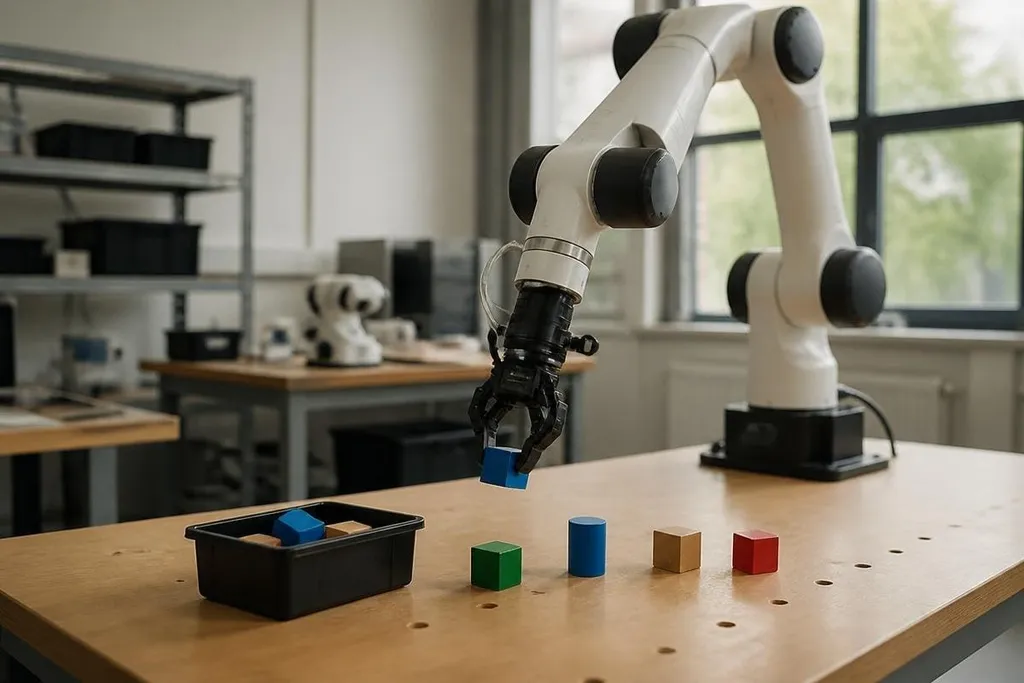
The robot starts with a task and a set of possible actions. It might move an arm, change its speed, or alter the force on a gripper. After each attempt, its sensors report the result.
A reward signal turns that result into a number. The robot gets a higher score when the action moves it closer to the goal and a lower score when it makes the task worse. Over many attempts, the software changes the robot's policy, which is the rule it uses to pick its next action.
That score doesn't need to mean money or points. In a physical task, it can represent a successful grasp, a stable joint position, or a safe distance from an obstacle. The useful part is the link between the action and the measured result.
The robot doesn't learn from failure in the human sense. It records which action led to which result, then adjusts its next choice. A dropped object becomes useful data only when the system can connect the drop to the movement, grip force, or timing that caused it.
Why random tries aren't enough
Random actions can damage parts, waste power, or create a behavior that works once and fails later. Training needs a defined goal, limits on unsafe actions, and enough sensor data to tell close results apart.
This is why many teams start in simulation. A virtual robot can repeat a task at low cost while the software tests thousands of possible actions.
The simulator still has to match the real robot's weight, joint limits, surface contact, and sensor noise. If those details differ too much, a behavior that works on screen may fail on the floor.
The move from simulation to hardware is often called sim-to-real transfer. Engineers can reduce the gap by changing the virtual conditions during training. They might vary friction, object weight, lighting, or sensor readings so the policy sees more than one clean case.
What the robot learns, and what it doesn't
Trial-and-error training works best when the task can be measured clearly. Clear goals let the robot receive a score for placing an item inside a marked area, keeping a walking body upright, or reaching a target without touching a boundary.
Less clear tasks create harder training problems. If the robot must decide whether an object is safe to move, the system needs a reliable way to judge safety. A poor reward signal can push the robot toward a shortcut that scores well but fails the real task.
A high reward score can hide a shortcut, so check whether the robot repeats the task when the object, surface, or lighting changes. Robot 24 can give you dated examples to compare with the trial results before the robot moves into a working site.
After deployment, learning can continue. The robot may meet its training goal on one surface, with one object, under one lighting setup, then need more data when the setting changes. That makes monitoring part of the system, not a task that ends when training stops.
The limits of learning by failure
Training on a real robot can be slow because each attempt takes physical time. Repeated errors can wear motors, bend parts, or create a safety risk near people. Engineers often combine learned behavior with fixed rules that limit speed, force, position, or access to restricted areas.
The data can fail too. A camera may miss a dark object, or a force sensor may report different values as parts wear. When the input changes, the policy may choose an action that made sense during training but no longer fits the situation.
I’d trust a learned robot only after its test covers the surfaces, objects, speeds, and failure cases it will meet at work.
A practical check before you trust the result
Use these questions when a robot maker presents a learning result:
- Name the task: What exact action counted as success?
- Check the setting: Did the test use simulation, a lab bench, or a working site?
- Count the attempts: How many runs were completed, and how many failed?
- Read the limits: What speed, payload, lighting, surface, or object range applied?
- Ask about recovery: What does the robot do after a drop, collision, sensor fault, or blocked path?
- Check repeatability: Record whether another team can run the same test and compare the result.
A learned policy can handle tasks that are hard to write as fixed instructions, but the result depends on the score, the sensor data, and the test setting. The next proof is simple: run the same policy outside its training conditions and count what still works.